
Every morning, compliance teams at community banks and credit unions arrive to queues of applications sitting in Manual Review. Each one follows the same chain of steps: leave Narmi, log into Alloy, interpret raw data across multiple fraud and identity vendors, cross-reference internal policy, make a decision, come back to Narmi, and log it. 8-12 minutes per application, repeated until the queue is clear.
Narmi’s latest AI release, AI DecisionAssist™, ends that workflow and brings the entire Manual Review process into the Narmi Command portal, powered by AI grounded in your institution's own decision history. This reflects Narmi's practical approach to AI: start with a specific customer painpoint, then apply AI as the mechanism to solve it, not the other way around.
Manual Review isn't rare. Roughly 25% of staff-led applications enter it, each taking an average 8-12 minutes to work through, and at any meaningful volume that adds up fast. But the cost isn't just staff time. The longer an application sits in review, the more likely a new user is to abandon it: 70% of financial institutions lost clients this past year due to slow onboarding (Fenergo, 2025 Financial Crime Industry Trends Report). Meanwhile, staff lose context and interpret the same signals differently depending on who's reviewing, so similar applications end up with different outcomes.
For business applications, the problem runs deeper. A KYB review means evaluating the business entity, each beneficial owner, formation documents, and ownership structure, each sourced separately with no automated guidance to flag what doesn't line up.
This is exactly the kind of repetitive, pattern-heavy work AI is built to improve.
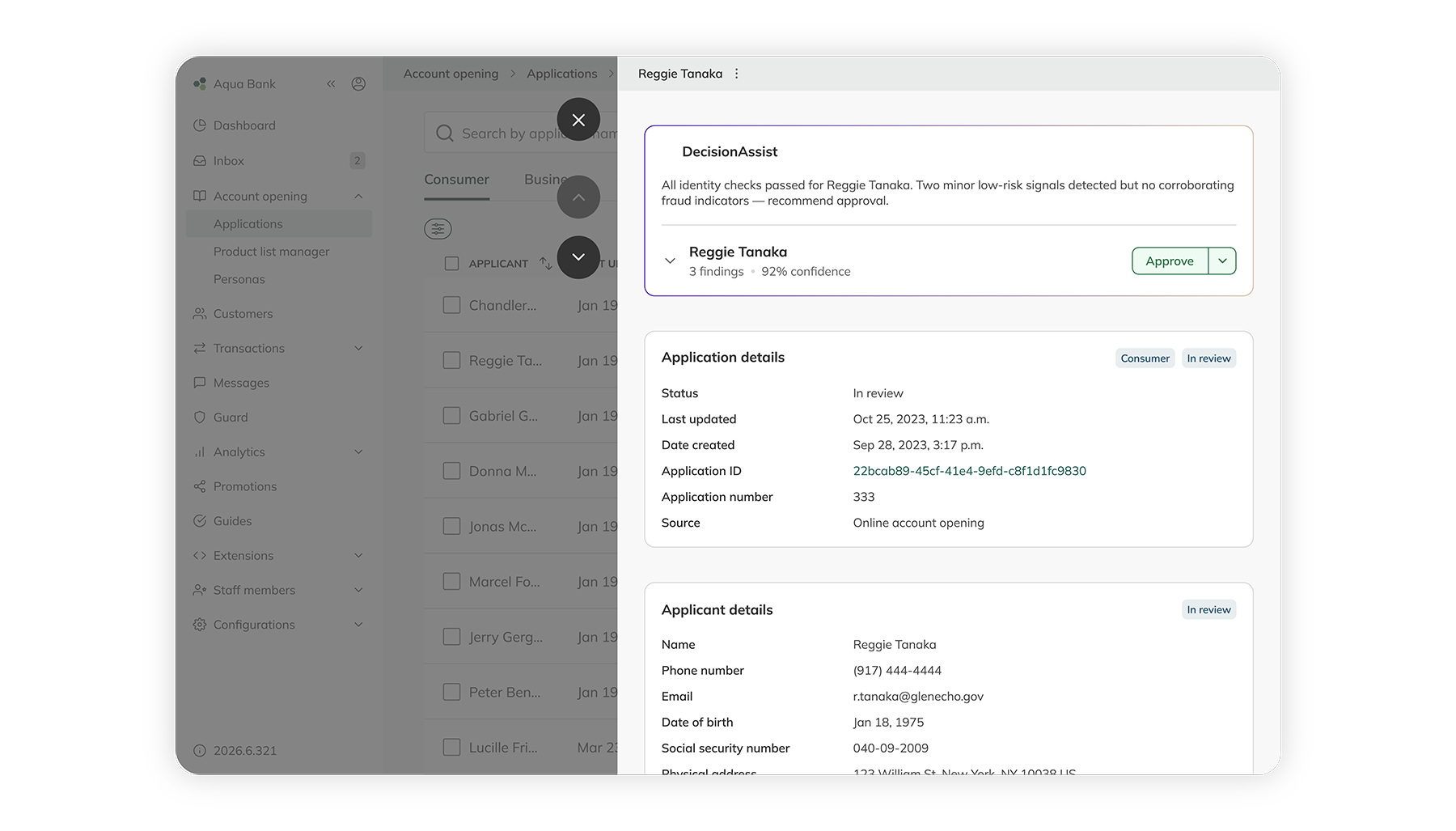
The moment an application enters Manual Review, a background analysis automatically queues and runs. No manual trigger required. In roughly 30 seconds, DecisionAssist completes its analysis and surfaces a structured recommendation card directly in the application detail view. By the time a staff member opens the screen, the answer is already there.
The card presents a color-coded risk level, a plain-language summary narrative, and per-entity recommendation cards, one per applicant for consumer reviews and separate cards for the business entity and each beneficial owner for KYB. Ranked findings come with severity badges, reason codes, and an expandable activity log showing exactly which data sources the agent consulted.
Staff can approve, deny, or escalate with a single click. When they override the AI's recommendation, notes are required, and those overrides feed back into the model to sharpen future suggestions.
DecisionAssist isn't trained on an industry-wide dataset. It learns from your institution's own historical review decisions: what you approve, what you deny, and where the ambiguity typically lives. Patterns that repeat at high volume, like an "out of state address" which accounts for roughly 30% of reviews at some institutions, are exactly what the model learns to handle consistently.
Model improvements never cross institution boundaries. Your data stays yours.
For institutions with limited review history, the team can back-test 100 to 200 prior cases before go-live, giving compliance teams a concrete look at how the agent would have performed on real decisions before they ever rely on it.
"We're giving staff the answer before they even sit down." - Nathan Gonzalez, SVP Engineering at Narmi
“By the time a staff member opens that screen, the analysis is already complete. They're not waiting, our suggested next step is already available before they even sit down. Every signal the agent used to reach its recommendation is logged, visible and explainable. We built this so that trust isn't just something we ask for. It's something staff can see and verify on every single decision."
Whether staff follows the AI recommendation or overrides it, every action is logged. DecisionAssist is built for environments where compliance and examiners expect full documentation, and that requirement is baked into the product, not bolted on. Every decision, every override, every data source consulted is part of the record.
It also addresses one of the most persistent concerns about AI in compliance workflows: the black box problem. Staff aren't asked to trust a recommendation they can't explain. Every card shows its reasoning, evidence, and confidence score. Override it if you disagree, and the model learns from it.
For a compliance analyst with 15 applications in the morning queue, the difference is two hours versus 30 minutes, with better consistency and a complete audit trail on every decision. For institutions with limited compliance staffing, it means review volume can grow without growing headcount alongside it.
That's not just an efficiency gain; it's a fundamentally different way to run a compliance operation.