

At a time when the business world at large is still in the learning process of how to approach AI, it can feel like banking, with its strict regulations and slow change of pace, has to move with special intention. But amid top-down mandates to optimize through AI workflows in other industries, financial institutions – and especially community banks and credit unions – have an opportunity to organically direct their AI investments through a tailored approach.
Instead of widespread, agnostic implementations, community financial institutions are in a moment of gathering feedback and responses, augmenting the workflows most logically improved by AI’s efficiency gains.
That process starts with hearing from the people on the ground – the community bank and credit union staff owning both all-important customer relationships and administrative tedium that they’d like to automate. This month, we’re digging into three statistics that describe how staff feel about how AI is being implemented at their financial institution, and where they think it has the most value.
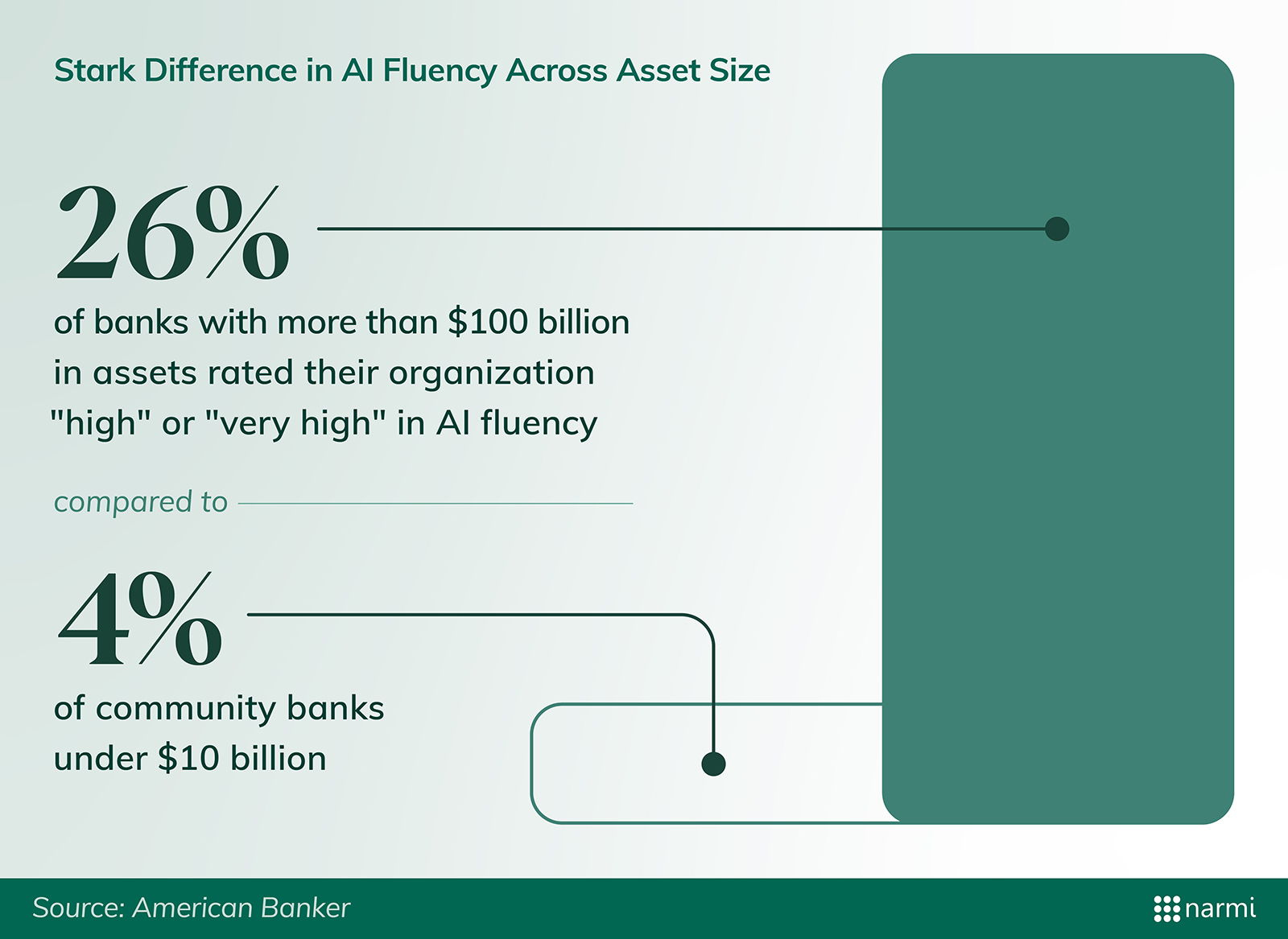
Financial institution staff are starting to see a divergence in AI fluency across the asset spectrum. According to a recent American Banker survey of banking professionals, 26% of employees at national banks with more than $100 billion in assets rate their organization’s level of AI fluency as “high” or “very high.” That number drops precipitously down to 4% for employees at community banks under $10 billion.
This makes sense on its face: large, publicly traded banks are under significant pressure to increase margins through efficiencies, and tend to implement AI initiatives at scale, keeping the resulting headcount reductions top of mind. Compare that to how community financial institutions could approach AI: with smaller teams and employees who tend to wear multiple hats, AI could be used as a springboard to make good on the promise of AI to augment the individual worker and enable growth. The lower number reflects a sense of organic uptake among community banks and credit unions, which tend to be more intentional in their application of the technology.
“It’s important to design experiences based on real staff needs; how they work, where they spend time, and the decisions they’re responsible for,” said Ayesha Imran, Senior Product Manager at Narmi. “That’s why our AI strategy centers staff as the decision makers, with AI acting as a co-pilot to amplify their expertise – not override it.”
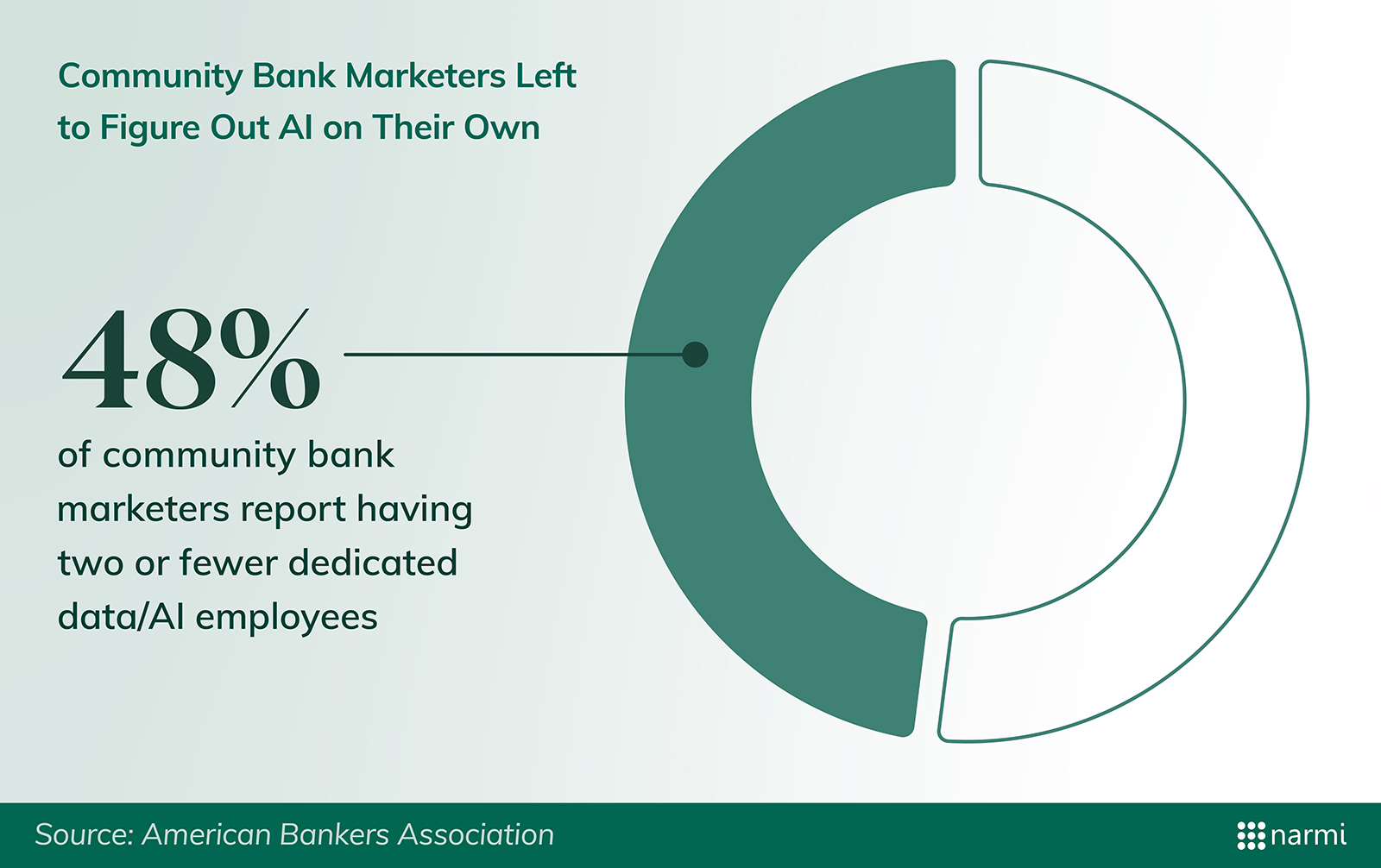
With that being said, financial institutions could move more quickly in one area where AI has obvious applications: marketing. When the American Bankers Association surveyed 130 bank marketers to understand how banks are currently using data analytics, they found that around half reported their organization had two or fewer employees dedicated to data or AI, largely leaving branch staff to figure out AI tools on their own.
This is in keeping with a narrative of organic experimentation and uptake with AI, but community financial institutions should continue to prioritize data readiness for future applications of AI, dedicating manpower to it as a foundation for future efforts. These employees can also act as knowledge centers for when these efforts scale.
“AI is still a new and rapidly evolving technology, so we’ve been intentional about focusing on use cases where it naturally excels today,” said Imran. “Marketing has been a strong starting point.
“What we’re seeing now is that unlocking more advanced use cases requires more than just experimentation; it takes dedicated resources, strong data foundations, and deeper internal expertise.”
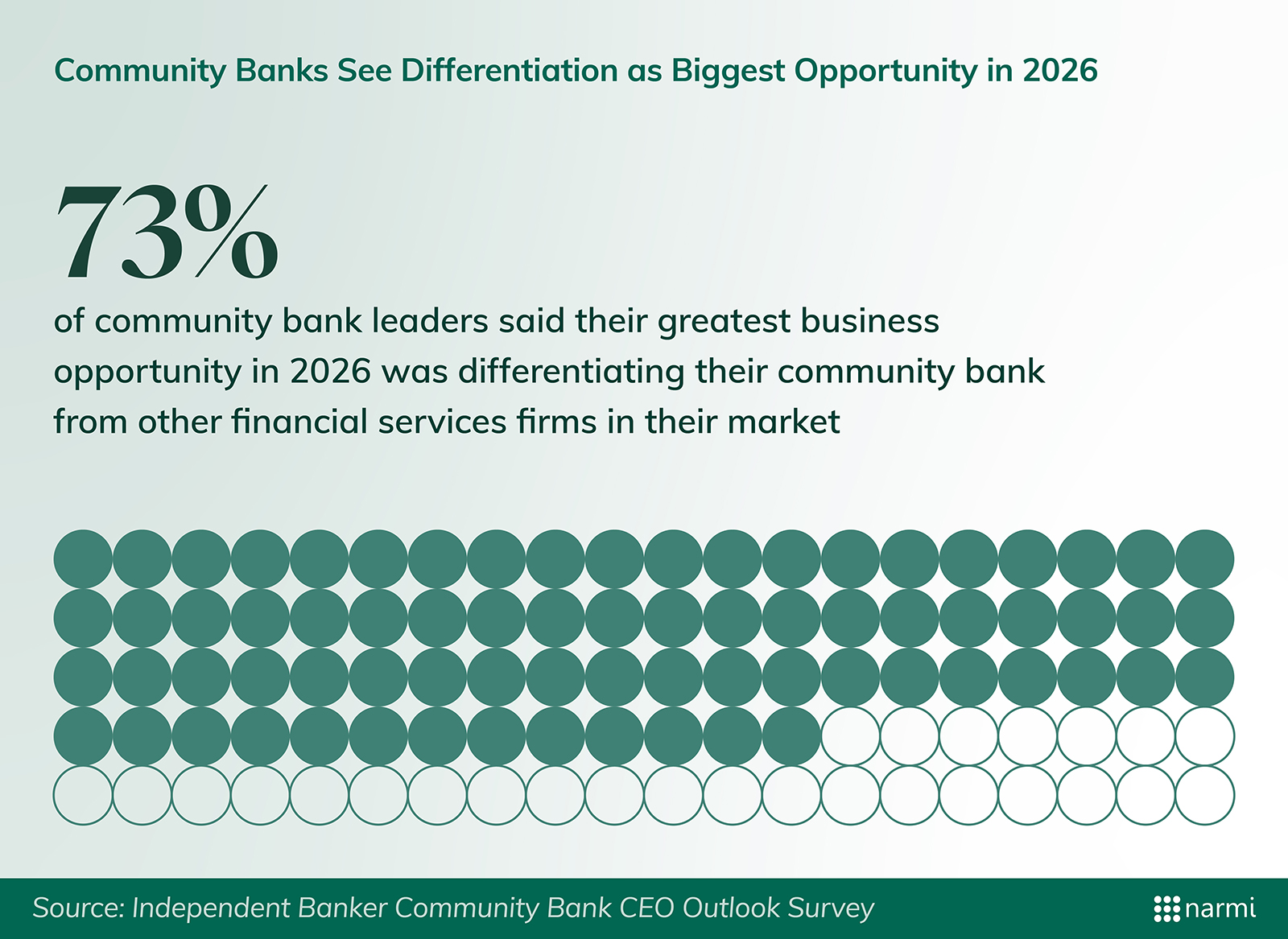
While not directly pertaining to AI, Independent Banker’s recent Community Bank CEO Outlook highlights an opportunity that adopting AI can fulfill: 72.8% of polled community bank leaders said their greatest business opportunity this year was differentiating from other financial services firms in their market. This includes all the regular hallmarks of local touch community financial institutions are good at – hosted events with community business leaders; readily available financial advice for younger generations.
But differentiation can also occur at the business level: building cutting-edge offerings directly relevant to the needs of your community, and taking a consultative approach to help businesses use technologies like AI. The notion of “primacy,” so prized in banking, begins with staff – a growing center of knowledge about the AI tools and applications that are relevant to your community’s financial needs, honed through organic experimentation and uptake.
What better way to differentiate than help bring your community into the future?
“Community institutions have always differentiated through relationships,” said Imran. “What’s changing is that differentiation can now also come in the form of helping customers navigate what’s next.”
“The role of the bank evolves from service provider to trusted advisor, and staff are at the center of that shift.”